
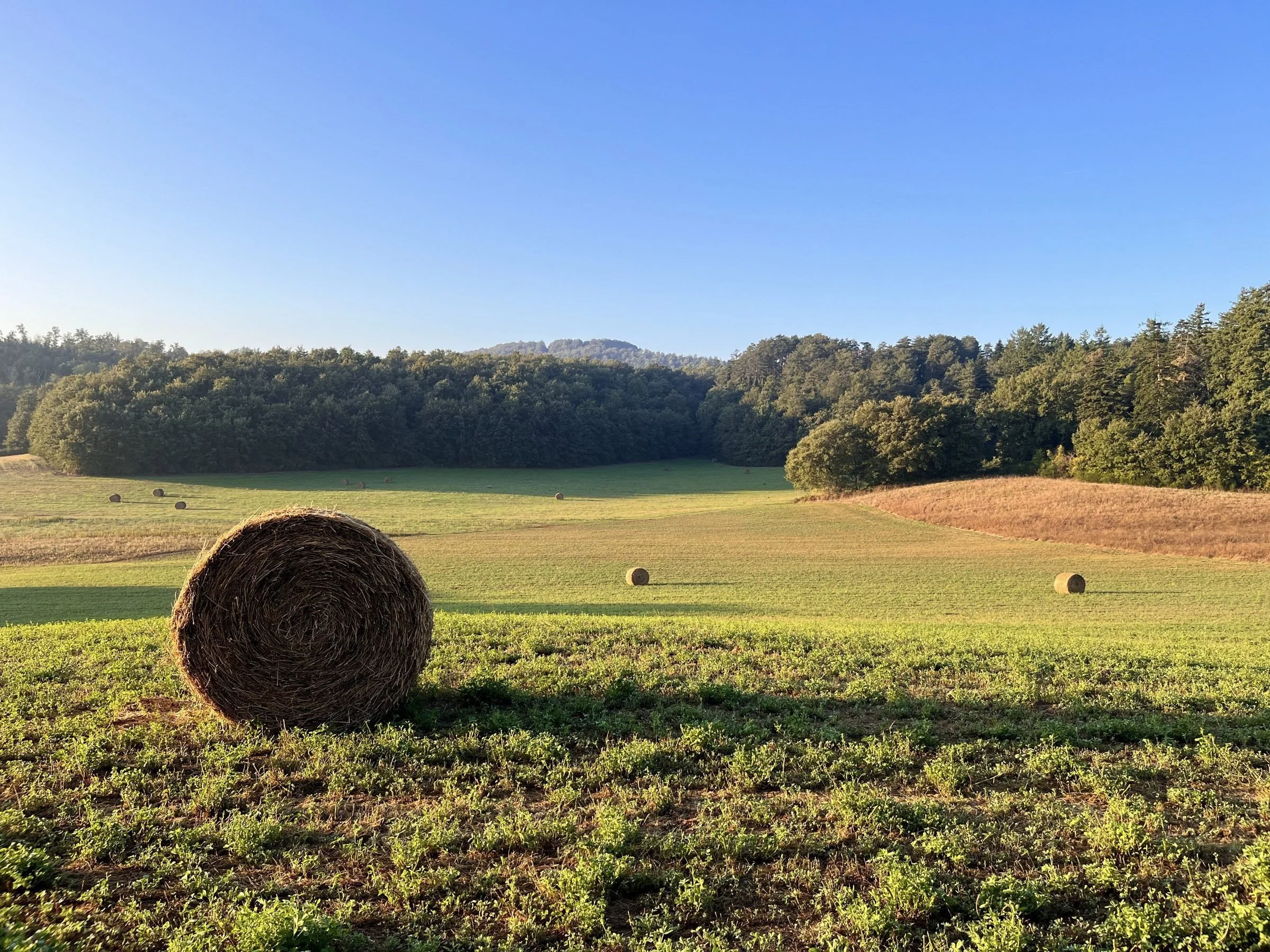
The estate’s hay meadows · [month and year]
The Estate
Our 35-hectare farm lies on the Alfina Plateau, at about 550 meters above sea level.
At its heart is the Selva Castanile, a chestnut grove we established in 2022 on fields that had been farmed as monoculture. We gathered more than 1,500 wild chestnuts, overwintered them, and raised them into saplings in our greenhouse. We then planted them nine meters apart in a silvopasture layout designed for grazing, and in the coming years we will graft a range of fine chestnut varieties onto this wild rootstock. Our growing fold of Highland cattle already grazes the grove, and hay from the nearby meadows feeds the herd through the winter.
In March 2025 we planted a small vineyard: one hectare of Pinot Noir and one of Viognier. We expect the first harvest in autumn 2027, and for production to eventually reach 8,000 bottles in good years.
In the meantime, we keep busy with the young orchard, the yuzu grove, and the no-dig market garden that supplies our restaurant, La Bettola Alfina. On one hectare of former meadow we have also planted about 400 Atlas cedars, grown from seed, to test how well this remarkably drought-tolerant and resilient tree does here.
Organic farming is defined by what we leave out; regenerative farming, by what we add.
Organic certification ensures that no synthetic fertilizers, herbicides or pesticides are used on our farm. It is a necessary starting point, but it says little about what happens to the soil over time. That is why we also follow the principles of regenerative agriculture, which measure what the land gains from year to year: more organic matter in the soil, a greater variety of plants and insects, and soil that holds more water after rain. It is a slow process with a long horizon, but we take great comfort in knowing that our changes, though small and incremental, are improving the land in ways that will last for generations to come.
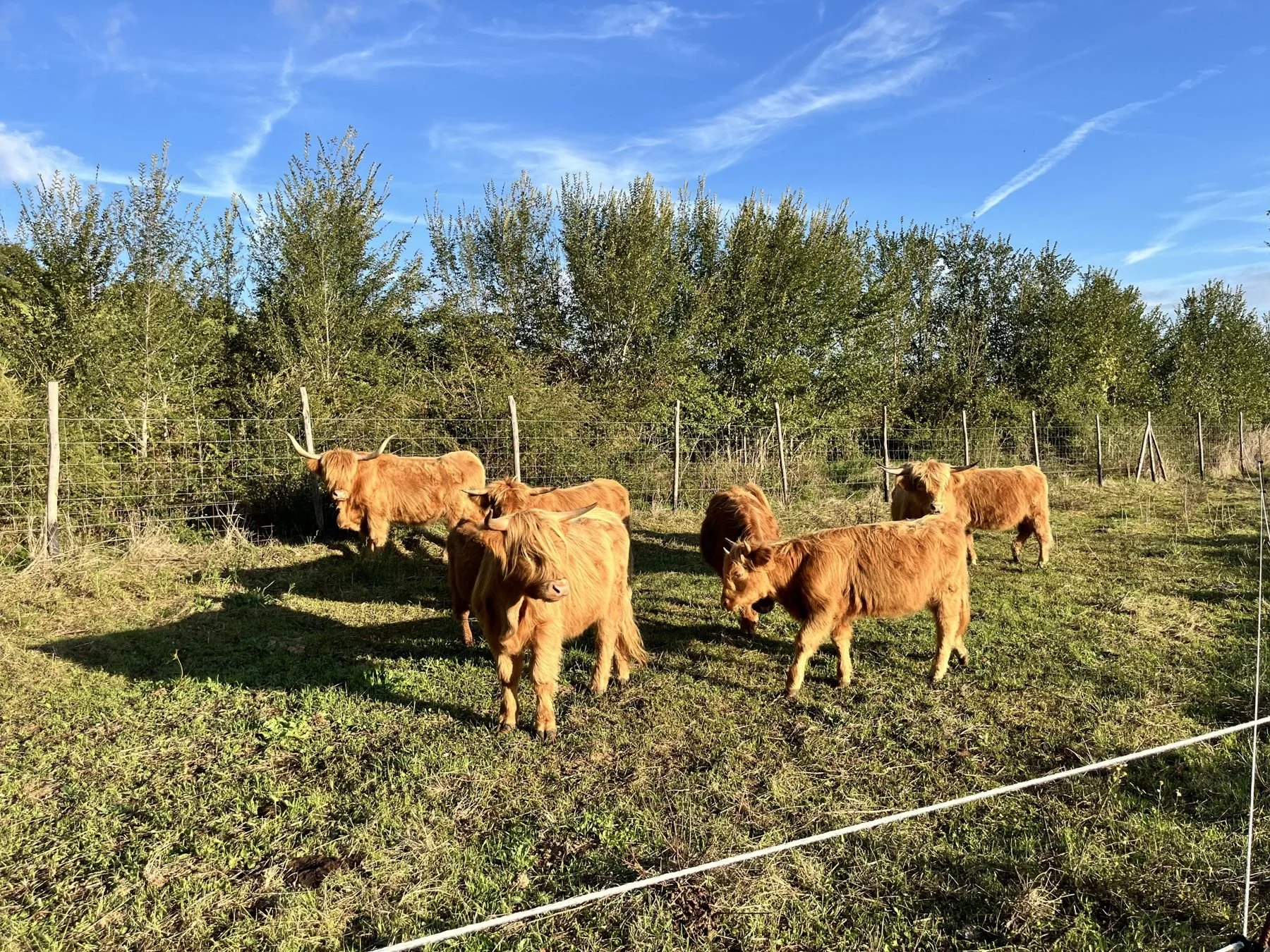
Rotational grazing
The Highlands stay on a small paddock for a short time and then move on. The grass is grazed, trampled and manured evenly, and then has weeks to grow back. It is a way of grazing that imitates wild herds, and over time it should lead us to a permanent, diverse pasture.
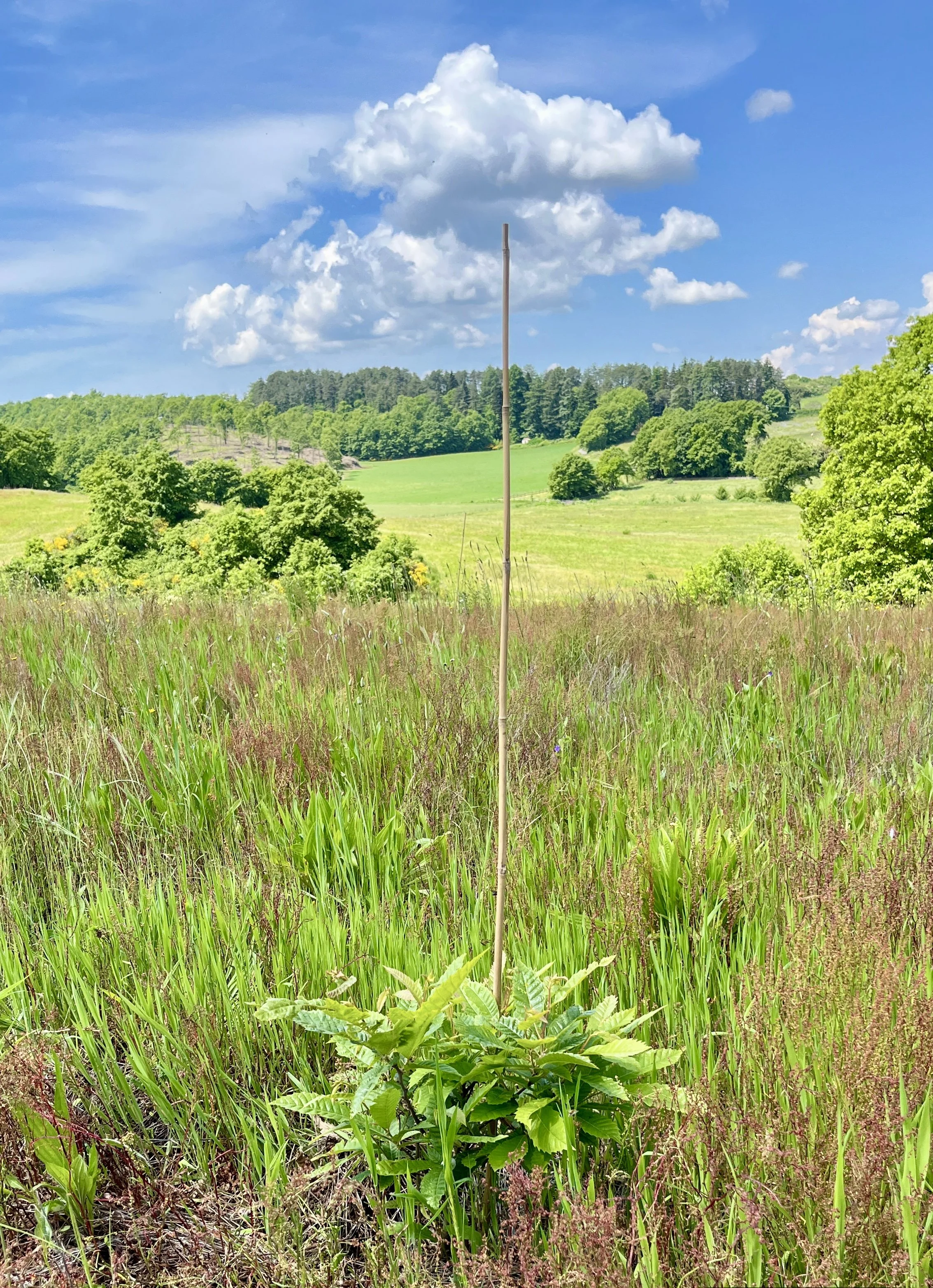
Silvopasture in the Selva Castanile
The chestnut trees were grown from seed collected from wild trees in the area, so that their roots are those of plants long adapted to this climate, and in the coming years they will be grafted with fine chestnut varieties. They are planted in rows nine meters apart so that there is room between the rows for grass and grazing. The same ground can then provide shade, forage and chestnuts, for centuries.

The no-dig market garden
In the market garden we neither plow nor dig. The soil is covered with compost and with paper mulch instead of plastic, and cover crops protect it when it is not being cultivated, so that the structure of the soil and the life it contains stay intact.
Why we do it
The land where the Selva Castanile grows today had been farmed intensively for more than fifty years, and we found it compacted and poor in nutrients. Rebuilding it is the first aim of everything we do.
The simplest reason is practical. Living soil holds water better, needs less intervention and copes better with difficult years, and on a plateau at 550 meters that matters. Animals that graze well and trees that grow together with pasture make the estate more resilient than the same crops would be if kept apart. The same practices reduce erosion and runoff, make room for more species of plants, insects and birds, and keep in the soil the carbon that plants draw from the air through photosynthesis.
There is also a longer-term reason: we want to leave this land in better condition than we found it. We do not have all the answers. Some of what we do is a trial, like the hectare of Atlas cedars, and other things we correct as we go. We write about those on this site too. In the same spirit, we try to use as little plastic as possible, with the aim of one day doing without it entirely, along with every other petroleum product.